


If You Have High Insulin Levels, What Do You Do?
Is This Actually an Energy Issue?
This question came up during a morning live inside the Health Blueprint:
“If you have high insulin levels, what can you do? How is this an energy issue?
It’s a powerful question because it looks beyond the typical answer of “just fix your diet.”
It highlights that blood sugar and insulin responses are energy issues. And that’s most likely different than the way you’ve been taught.
To best understand, let’s start by defining energy…
When I say energy, I don’t just mean calories, which is where a lot of the conversation on energy lands. The energy I’m referring to is the kind your body produces. It’s your body's ability to produce fuel efficiently, respond to stress, regulate hormones, and shift between burning and storing.
The amount of energy your body has affects your capacity to move through life, and that, in turn, affects everything from your nervous system and mitochondrial function to your relationships and joy.
Insulin is just one thing that lives inside this energetic system.
Now, to be clear, this conversation isn’t limited to insulin or blood sugar. It’s the same concept for every function of the body, as energy lies at the very foundation of health. It’s also why most hormonal problems aren’t really hormone problems, but energy system problems that are triggered in your brain, shifting your hormonal patterns.
It’s all a function of energy.
Going back to insulin and blood sugar.
Insulin is often referred to as one of the body's master hormones. Its job is to help you move glucose out of the bloodstream and into cells so it can be used or stored. While food absolutely influences insulin (we’re not debating that), what is often overlooked is how much your stress physiology influences it, too.
When stress is high, cortisol rises. Cortisol then increases blood sugar, which in turn requires more insulin. If that pattern repeats often enough, cells become less responsive to insulin over time, leading to insulin resistance. And it doesn’t happen from food alone, but from energy signaling.
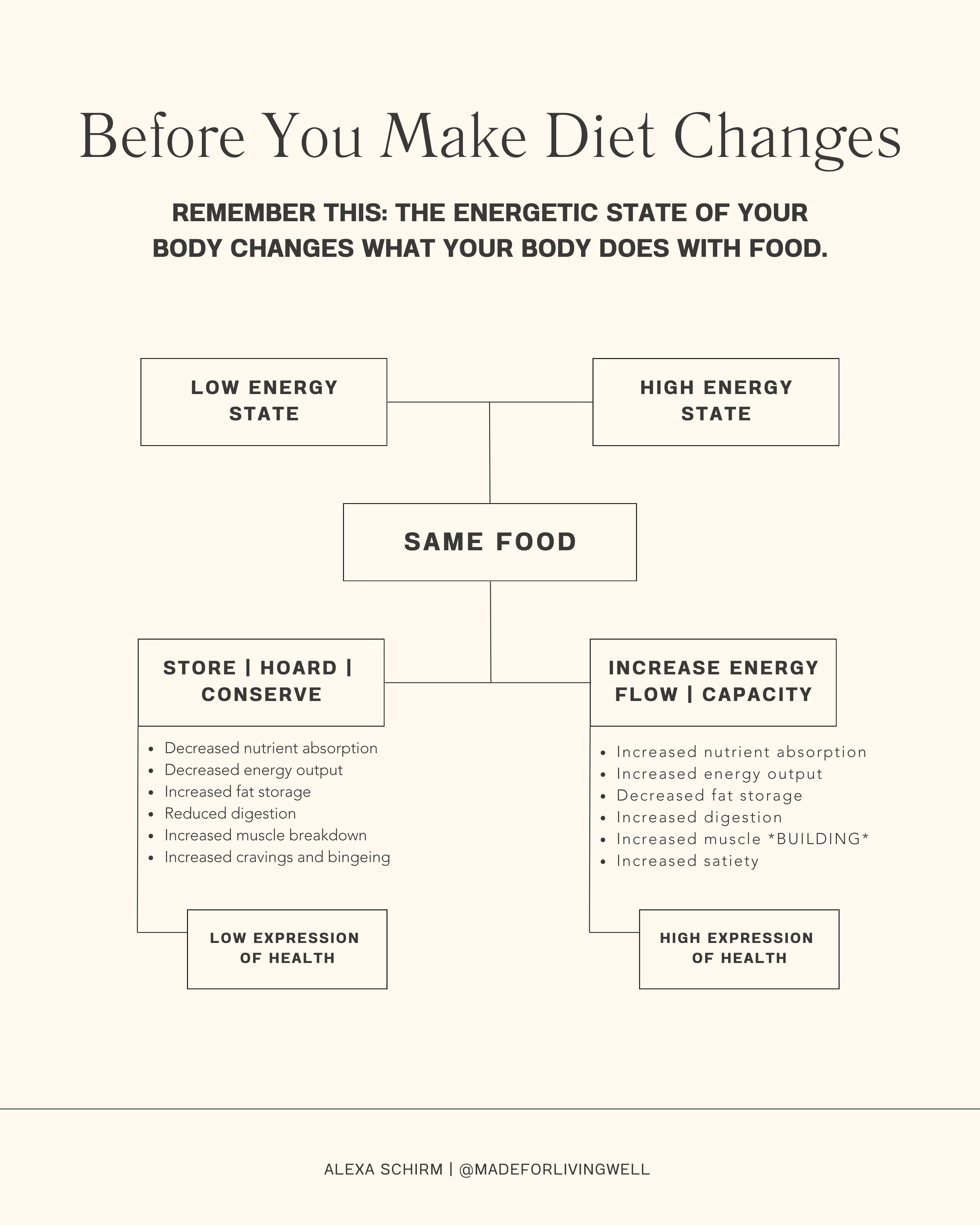
That’s why the same meal eaten in two different states can be metabolized differently. A meal eaten when you’re calm, rested, and grounded is metabolized differently than the same meal when you’re underslept, overwhelmed, and tense.
Your body responds differently depending on its energy level (you could also insert stress level).
As I always say, health outcomes are less about what you do and more about how your body responds to what you do.
Making health a metric of how your body responds.
Step One: Change How Your Body Responds
Your brain and nervous system are responsible for perceiving safety, which determines your body's biological responses. How safe your body feels depends on your body's capacity, which is a metric of energy.
In a low capacity state (or when living a low expression of health), your body can’t handle much, which is why it shifts to conservation mode, changing not only how insulin functions but also your blood sugar response.
I call this the scarcity problem.
When energy feels scarce, your body protects you. It lowers metabolic output, stores more readily, burns less efficiently, and increases your cravings and drive for quick energy from carbohydrates and fat.
This isn’t a character flaw. It’s protective biology. It’s also usually the moment when people jump on a diet.
I get it.
Your jeans start feeling tight. You get the lab work back. Or you’ve seen a similar but different social post about how blood sugar is ruining your health. Your immediate response is to change. It’s to find a solution to what is or could be your problem.
Action is wonderful, but as we’ve been talking about, and what I had to learn the hard way is that change without capacity rarely works.
Which is why your serious attempt at the all-or-nothing, cutting out the carbs, or cutting out entire meals while boosting your workout plan doesn’t pan out. It feels productive, even responsible. Like you’re finally doing something. Even more confusing is that it often works, at least in the short term.
The problem isn’t the change. Change is necessary to change.
The problem is that if your system is already in a low-energy, high-stress state, aggressively attempting to change only adds to the stress load. You move from over-eating to under-eating, all while still overthinking food and attempting to will yourself out of cravings, and then wind up in the same place you started.
Take a lesson from me: You cannot bully your body into safety.
You cannot restrict your way out of a stress state. And you cannot out-discipline a nervous system that feels threatened.
That doesn’t mean food doesn’t matter. It absolutely does. But food works inside a system. And if that system is out of balance and undercharged. Changing food alone won’t fix it.
Before you eat… focus on this.
Before you overhaul your diet, stabilize your energy. Build capacity. Because even healthy changes require energy.
I know it’s a mind twist, especially in a world that has set your food intake on the ultimate pedestal. But there’s a lot more to it.
For example, if you’ve ever lost a night of sleep or habitually lose sleep, that alone can make it almost impossible to eat healthier. Not because you lack willpower, but because at that point, your biological drive is to hoard energy.
Before you make any big changes to your diet, ensure your body has what it needs to use the food and make the changes you seek. There’s nothing worse than making a big life change and having it not work, which only drains you rather than fills you.
Again, you (and your body) are not the problem. It’s a biological protective barrier that you must learn to work with, not against.
Fueling your energy tank and charging your body battery are most important.
That means things like sleeping consistently. Getting morning sunlight exposure to regulate your circadian rhythm, daily movement and eating regular meals that signal predictability and safety. Eating in a calm state rather than while rushed, scrolling, or stressed matters. Connecting with life and practicing more ways to fill your body.
It also means being conscious about what you fill your mind and (perhaps, especially) your soul with.
These basics improve insulin sensitivity and help optimize blood glucose, not because they band-aid it, but because they improve the overall capacity and energy, and that changes your body’s signaling.
Food matters.
I sound like a broken record, but I want you to hear me. Food matters.
But food works inside a system. And if the system is in scarcity, changing food alone won’t fix it.
Health isn’t just about what you eat. Again, it’s about how your body responds to what you eat. It’s about how much energy your body has to use food or if it’s going to store it.
When energy improves, blood sugar often improves.
When capacity increases, regulation follows.
So before you go and make any big diet changes, ask yourself: Do I have the energy and capacity to support this?
If it’s a no, do something to change it!
That’s why inside the Health Blueprint, we focus on the basics first. Not because food doesn’t matter, but because food works better when the body has energy.
If you’re not part of the Health Blueprint course, it’s never too late to join. All you ned to do is become a paid subscriber. Once you join, you can watch the masterclass on building energy here.
Then, join us each morning live right here, where I continue to cover topics like this while encouraging you to take action on the basics.
Below you’ll find a morning live on hormones — and how your hormones are most often just an energy problem.