
We all have different strengths. For instance, I’ve realized some people are really good at organizing their cupboards and drawers, and some of us aren’t.
One of my friends brought this to my attention. In her words, and I quote, “I realized we’ve been friends for a long time, and I never opened your cupboards before. So I just did.”
“Annnnnnnnnd???” I responded.
“I think it’s interesting.”
“Interesting?”
“I mean yea, it’s just not what I expected.”
You think this entire exchange is weird, but I actually love that it happened. I love that I have friends who aren’t shy about looking under the surface of my life. And I mean more than just my cupboards. We all need people here who look a little deeper.
I actually didn’t feel judged in the slightest. I know my organizational logic isn't what one traditionally defines as organized. I’m more of a type B person than type A (some of you have already pinned this on me). Which is why the exchange opened me up to ask a different question: Is there a better way to do this?
When I texted her and asked, her response was spot on:
DOES IT WORK FOR YOU?
I mean, can we talk about that wisdom?
It’s easy to compare and mimic what is working for other people without ever stopping to wonder: is it working for you? Because if it is, why fix it?
We have enough things to fix in our lives. Finding the perfect place to put your wooden spoons doesn’t need to be one.
I bring all that up to say it’s my heart behind everything I share. It only matters if what you’re currently doing isn’t working for you. And if it isn’t, which usually shows up in the areas you complain about or create drama around, let this be inspiration.
Not the end-all-be-all. Just ideas to find your own way to getting healthy food on the table.
Because while I might not be “skilled” at organizing. I am skilled at making the most of the food I buy.
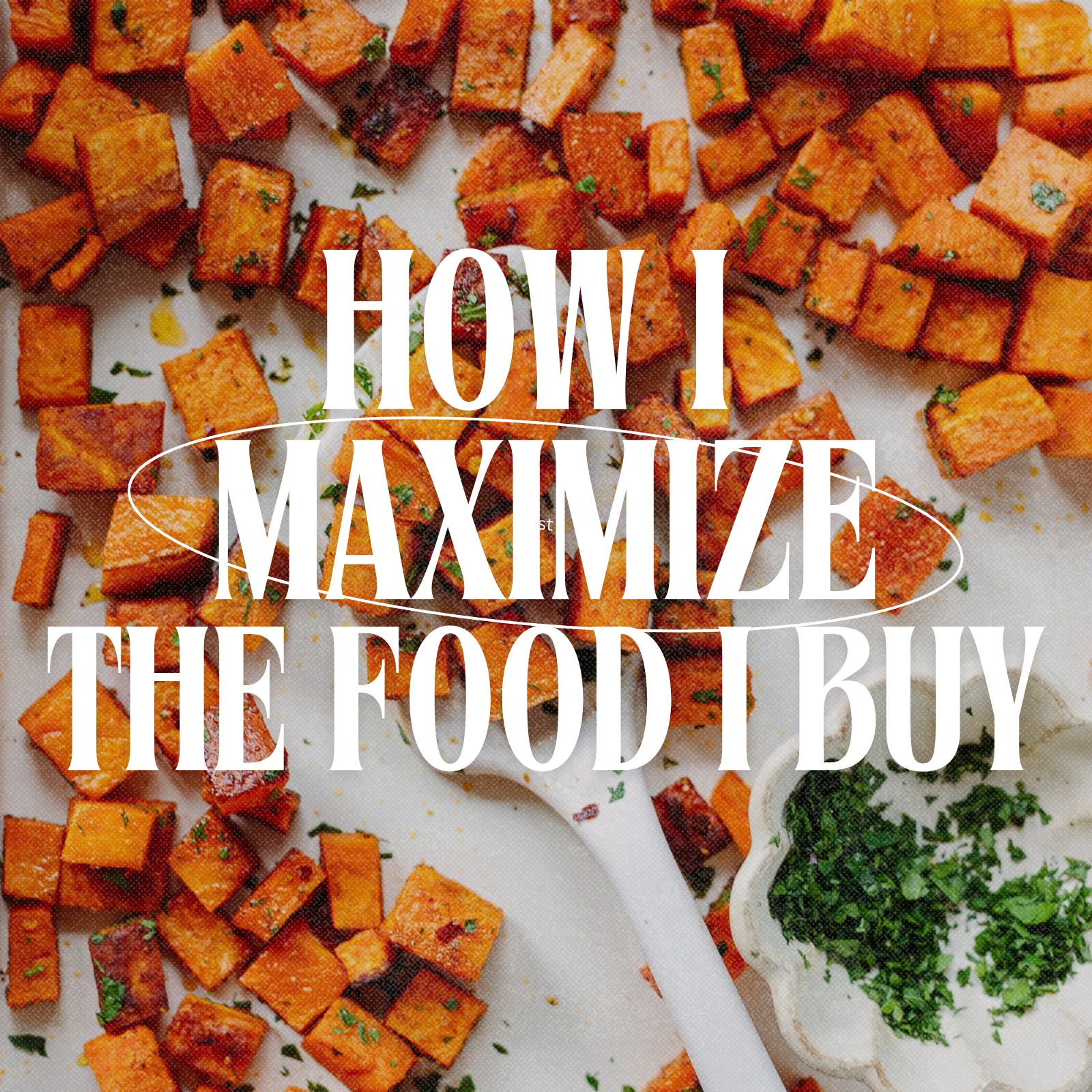
How To Maximize The Food You Buy
I like to give credit to the strong lineage of my bloodline that must have encountered some real food scarcity, because I rarely throw food away. Or maybe I’m just in my Little House on the Prairie Era. Either way, I’m skilled at making a meal from nothing, and I’m somewhat passionate about that challenge.
Now, I understand not everyone has that same genetic pattern, which is exactly why my obsession with using what you have might actually help you.
Here are some basic tricks I use to maximize the food you buy (and save some real money on groceries):
Tip 01: Meal plan based on what you have to USE UP.
This is the best tip, hands down. If you’ve got a head of lettuce in the fridge, add a Cobb salad to the plan. Drowning in tomatoes? Make homemade pasta sauce or basil tomato soup. Leftover chicken? Enchiladas. The key is to not assume you have to throw it away. Instead, learn to build meals around it.
Every week, I start planning from what’s already in my kitchen, not from a Pinterest board.
NOTE: This is also where a “use-it-first” shelf earns its keep. Pick one spot in your fridge, a shelf, a bin, whatever, and that’s where anything on the verge of going bad lives. Not buried in the back where it dies quietly. Front and center, staring at you every time you open the door. It’s a dumb-simple system, but it works, because you can’t meal plan around what you’ve forgotten exists.
Tip 02: Use the same BASIC ingredient over multiple recipes.
I call this batch cooking (learn the complete system here). It’s essentially this: if you're making a whole chicken in the crockpot, plan two or three meals around the shredded chicken it gives you. Or if you just hauled home a head of cabbage the size of your actual head from the farmers market (like I just did and somewhat regretted), line up a few recipes that use cabbage, so you actually get through it this week.
03: Process you haven’t used (assuming it’s something you can).
I wanted to say "freeze or pickle it," but let's be honest, those words can feel intimidating. I've had a long, rocky history with freezing food. I think it's a good idea, but I get lost in how big it feels, which is really just code for questioning how do you actually do it?
I've also been historically bad at using up what I freeze. So I've gotten specific about only freezing what I know I'll actually use.
I’ll occasionally freeze a full meal (like making two pans of enchiladas when I’m already cooking one). But mostly, I’m better at freezer snacks, quick freezer breakfasts to warm up, or freezing basic (ahem, batched) ingredients.
I’ve also realized the power of freezing single-servings of leftovers. Did you know you can freeze leftover soup in a single serving, and it’s the perfect thing to pull out on a cool fall day to reheat for lunch? Genuinely one of my favorite tricks.
Note: These are a great way to freeze single servings of soup (it’s definitely better than what I used to use… you’ve been warned, popsicle molds aren’t great for this).
Here’s what I’ve frozen lately:
Homemade Biscuits (my girls love these for breakfast with eggs)
Breakfast burritos
Homemade bone broth
Muffins/Cookies (for school lunches)
A gallon bag of vegetable scraps (onion ends, carrot peels, celery butts) that I toss in whenever I’m chopping, until I’ve got enough to make bone broth with
Leftover soups and casseroles (frozen in single-serving sizes)
Leftover taco meat, sloppy joes, meatloaf, etc
Chopped shredded chicken (for a good protein dump to make a quick soup)
Important Note:
I want to be clear: I’m not setting aside special time to cook things just to freeze them. That’s always been the hard stop that kept me from doing this at all.
My real secret is making extra of whatever I’m already cooking. Last week we had creamed chicken on biscuits, so I just tripled the biscuit batch while I was already making them (can we acknowledge biscuit recipes never make as many as you would assume?!).
It’s the same with muffins or cookies. And the bone broth I just simmer overnight while I sleep, then strain, cool, and freeze in the morning.
Don’t complicate it, and don’t assume it takes more time than it has to. That’s a story that’s been told about healthy cooking, but it doesn’t have to be true.
A few other things I’ll process:
I pickle leftover red onion, because no recipe on earth ever uses a whole one. And honestly, I might like pickled onion better than raw at this point.
Leftover cucumbers become a jar of refrigerator pickles.
I’m sure there are other things, but you get the idea!
And before anyone judges how realistic “pickling” sounds (I know my sister is judging me right now), pickling a red onion is slicing it, which you were already doing, putting it in a glass jar, topping it with mostly water and a little vinegar and salt, giving it a shake, and putting it in the fridge. That’s it. I promise it’s easier than your morning latte.
04: At the end of the week or when you’re looking to plan again, REPEAT THE PROCESS.
Look at what's left, what's about to turn, and build from there. That's the whole loop.
All of this obviously requires meal planning. And if you feel a certain way about meal planning, let me challenge you: is it the idea of planning that gives you the ick, or the way you were taught to plan? Because it doesn’t have to be either.
Here’s how I actually do it and it takes less than ten minutes on an average Thursday night.
Open the fridge and a notepad.
Write down any foods or ingredients that need to get used up.
Check the pantry for staples.
Jot down three or four meals you can make around these ingredients.
Fill in the gaps with the remaining needed items.
Do a grocery run.
That’s the entire system. No spreadsheet, no meal-planning app, no color-coding.
You could add, LET IT BE EASY.
You don't need extravagant meals every day, or ever. Most people who eat healthy consistently keep it pretty simple. Sure, try new things, but most nights, lean on what's familiar. Because I promise, when you get home from work late and everyone's hangry, you need to trust you can get a meal on the table fast. That trust is built on the confidence to know you can. And that means doing what's familiar more than what’s unfamiliar.
Let the unknown fuel your creativity, but let the familiar carry the weight most nights.
Examples of how to maximize the food you have:
Head of cabbage —> Egg Roll in a Bowl
Tomatoes —> Homemade Blender Salsa
Lunchbox Peppers —> Breakfast Burritos
Taco Meat —> Beef Enchiladas or Sheet Pan Quesadillas
Shredded Chicken —> Asian Chicken Salad
The small amounts of random mixed noodle shapes —> Minestrone Soup
Avocados (nearing the verge of no return) —> Avocado Toast Bar
Bananas —> Banana Muffins (Half for now, Half for the freezer)
Bone broth —> Soup
None of this is about becoming a different kind of person. It’s the same lesson my friend handed me with the cupboards. Does it work for you? If your system already does, keep it exactly as is. If it doesn’t, here’s a place to start.
What’s one food you most commonly throw away?
Let’s get creative in the comments about how to use it instead of tossing it.


