


Who makes an anti-gratitude list?
The audacity, am I right? And yet, because I feel the need to highlight all of my hidden health secrets (like nude sunbathing), here we are.

I don’t want my words to get twisted. This isn’t about being ungrateful. The anti-gratitude list has actually made me 1000 times more grateful.
Here’s the thing. I used to make gratitude lists believing that if I wrote enough stuff out, I would actually feel joy. And don’t most of us write gratitude lists not because we want to be more grateful, but because we think gratitude will get us somewhere?
We tie a lot of emotions to gratitude. Like, why, when we’re burnt out, frustrated, or losing hope, is the common answer, “just be more grateful?” Like that will do the trick.
I sat through six therapy sessions on a stiff couch and spent over $600 building a gratitude list that never made me feel more grateful.
For many years, I just assumed I was broken.
The reality was, it wasn’t about being ungrateful at all. My gratitude was just out of order. You can’t just write things you don’t believe, and you can’t just override what you feel.
Now, this is going to sound totally off the wall, so I beg you, if you read the next statement, promise me you will read the entire post.
I started to realize maybe my lack of joy wasn’t because I was ungrateful (which is why my gratitude list was just pen on paper), but because I actually liked the pain. I needed it.
The hard things felt familiar.
It was when things got too good, when I became happy, that I felt most uncomfortable.
Happiness wasn’t gratitude. It was waiting for the other shoe to drop.
I wasn’t ungrateful. I just needed pain, like I needed air to breathe.
Of course, our world makes these drastic assumptions. Anytime you feel anything but perfect, anything but good, anything but radiating happiness, you haven’t arrived. Something is wrong. You must be depressed.
But actually, I found it was my fear of pain, my fear of sadness, and disregard for feeling anything negative that created more of it. Or at least kept me creating what I hated.
When the truth is, we can’t feel what we want to feel without also feeling the opposite. Meaning we have to feel the sadness to feel happy. We have to feel pain to experience love.
As Theodore Roosevelt said: “It is only through labor and painful effort, by grim energy and resolute courage, that we move on to better things.”
Now, this is by no means a post promoting perpetual pain and sadness. It’s just highlighting that your attempt to get away from sadness or pain may actually be creating more of it.
That’s what I found with my gratitude list days… deep in my subconscious, it created more pain. Not because I wasn’t grateful. I was. But simply because I missed the understanding that I actually needed to feel some pain. I needed to feel sad.
Insert: The Sad List
Just yesterday, I just had this conversation with my husband. We were having another one of our deep conversations he looooovessss (insert sarcasm), and I noticed him saying what he generally says: “That makes me really sad.”
And I stopped him and asked…
“Do you ever wonder if you like to feel sad?”
Maybe you’re always “sad,” or creating situations that make you “sad,” because part of you needs it?
Of course, I don’t think pain, sadness, and abandonment are what we’re here to experience, even though they very much are part of the human experience. They’re more like what we’re here to heal from.
Which is how we started talking about building a sad list. It came from the question:
“What would it be like to feel sad on purpose and with purpose?”
I know, a sad list sounds really depressing.
Which is why NO ONE IS TELLING YOU TO DO IT. It seems like the opposite of what you want. And YET, it might be just the thing that stops you from creating sadness and instead choose when and where you feel it.
When you feel what you need to feel and choose how you feel it, you stop subconsciously creating it, opening space to feel a lot of other things.
My ungrateful list
While working on this post, I went back through my notes from those early days of therapy. I noted my “gratitude list,” but around session six, I have an ungrateful list.
Obviously, written in full rebellion of the work I was supposed to be doing. Which is fitting for me.
Sure, if we really define ungrateful, it’s grim. Completely self-centered. Dismissive and lacking appreciation for life. Which is also kind of the point. When I wrote out my ungrateful list, listing everything I felt was missing in my life, it sounds very self-centered. It is.
And YET, saying it seemed to free me.
It didn’t perpetuate my ungratefulness; it actually helped me define what I was really grateful for. Maybe not right away, but I’ve noticed this over time.
My ungrateful list highlighted the place I was spending most of my time stuck, and in a roundabout way, it also showed me what I was grateful for.
Here are a few things I jotted down on my ungrateful list:
My health that seems to be deteriorating every day
I’m ungrateful for my C-section
I’m ungrateful that I have to carry the entire mental load of this whole house
My career that looks nothing like I had hoped
I’m ungrateful that I keep doing everything right and still feel stuck
There were a few more I’ll leave unmentioned here (because you might actually cancel me).
OF COURSE all of these could have been argued. I KNEW I had so much to be grateful for. But what these offered that my gratitude list didn’t fully have was honesty. My mind and body didn’t want me to override what felt bad by latching onto the good.
When I wrote it out, I was honest and aware of what I was feeling, which helped me understand what to do about it.
Plus, that ungrateful list voices the hurt inside of us, letting it out on paper so it no longer controls us. Your words have power (literally, your vocabulary could be the nutrient your body is missing *LISTEN TO THE PODCAST HERE*), and writing or speaking what you feel helps diminish the power of what you feel.
David did it first!
For full justification, because I sound crazy, I’m going to use the Bible to back up this “ungratitude” list.
David did it first.
I promise, I didn’t put the pieces together until recently, but the ungrateful list isn’t even my idea. It’s all over Scripture. They just call them laments.
Psalm 13 opens with David saying, “How long, Lord? Will you forget me forever?”
He doesn’t clean it up. He doesn’t skip to the pretty parts. He says the honest, ungrateful, it-feels-like-life-sucks, and you-forgot-about-me thing out loud.
And then, only after he’s emptied it all out, he lands somewhere completely different: “But I trust in your unfailing love.”
He’s honest first (clears space)
Then inserts praise and gratitude second (fills it up)
It’s not the other way around.
I think that’s why my gratitude list never worked. I was trying to skip straight to verse five without writing what “feels” most honest first.
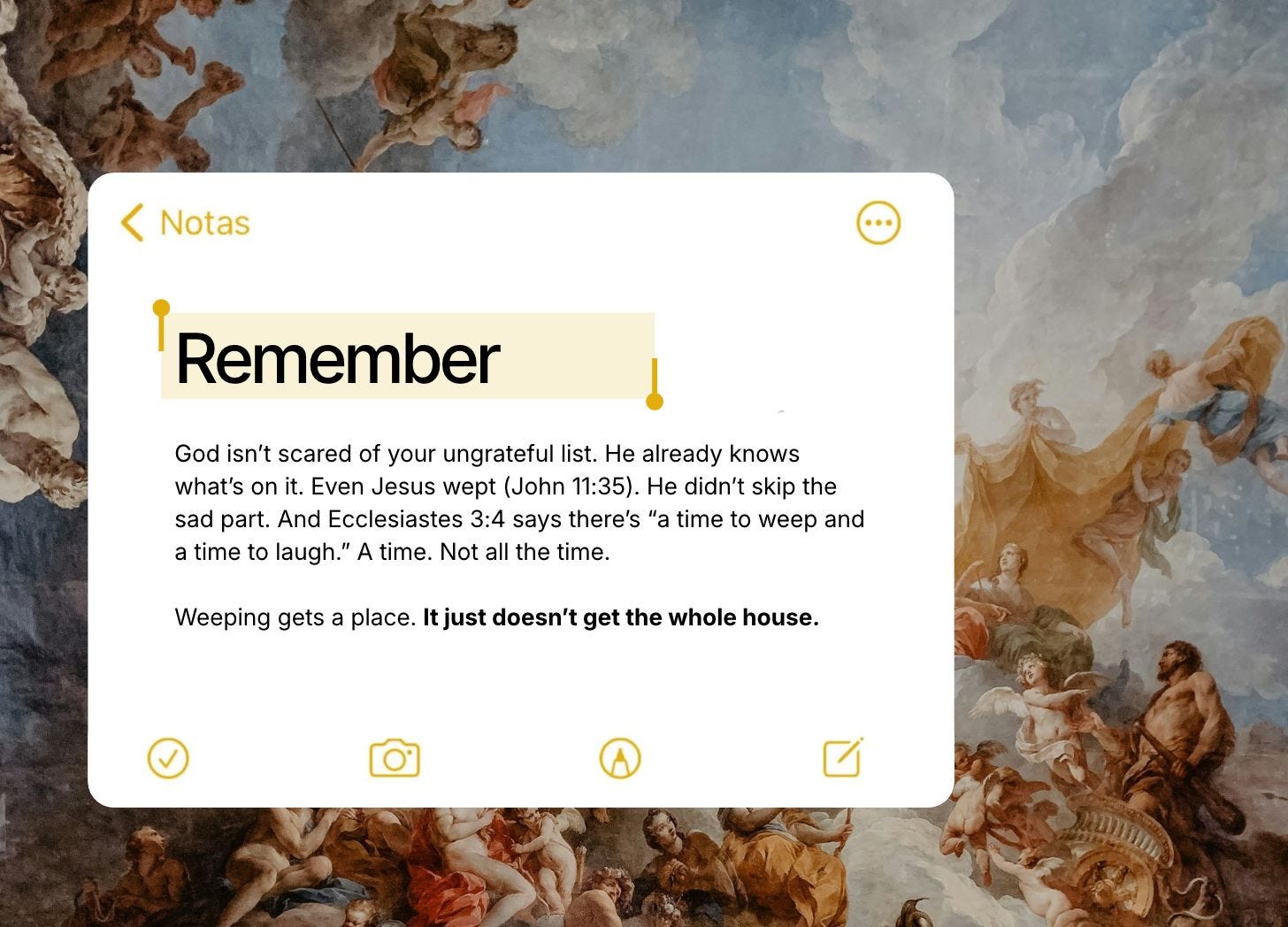
Guys, GOD ISN’T SCARED OF YOUR UNGRATEFUL LIST. He already knows what’s on it. He didn’t skip the sad parts. It’s what he’s here for. He’s in the business of redeeming what is broken, bringing it back into his perfection.
Story Edit: Feelings are more flexible than we think.
That’s the thing about feelings and emotions. You like to feel what’s familiar. You create patterns that become safe, even in feelings you hate. Running from or attempting to bury what you don’t want to feel, or trying not to feel it, never works.
You have to be honest about how you feel and then choose how and when you feel it. You work with the feeling, shifting it toward something healthier and better.
It also helps you see that feelings aren’t as set in stone as we think. They’re actually pretty flexible. Pliable. Even shape-shifting.
And I like to think this is the emotional maturity we’re all looking for… and the answer to our big “nervous system dysregulation” problem. NOT just coddling yourself back to regulation.
Emotional maturity - true regulation - is being able to feel a range of emotions and DECIDING HOW YOU WANT IT TO GO.
It’s feeling it without being controlled by it.
Can I be honest?
I think a lot of us feel a lot of things, and the reason we can’t change how we feel is that we’re not honest about it.
It’s not just you not being honest. The world isn’t either. They’ve attached feelings to labels. Making you believe things that just aren’t true.
Can’t we just feel sad without calling it depressed?
Can we feel worried without calling it anxiety?
Can we feel pain without needing to escape it?
The cure for my pain addiction was choosing how and when to feel it.
Just like I think the cure for my husband's perpetual need to create sadness might be giving himself permission to experience sadness on purpose, so he can feel it and move on from it in whatever capacity that looks like (I’ll report back).
It’s also how you stop the spiral and live out my mom's wise words (read it here).
What’s your perpetual feeling?
We all have that thing. That feeling we perpetuate.
It might be:
The one who always needs to be busy, because slowing down feels like falling behind.
The one who always has something to worry about, because calm feels suspicious.
The one who’s always a little angry, because angry feels safer than hurt.
The one who keeps life a little chaotic, because peace feels boring (or worse, unfamiliar).
I’m just asking: what if that thing doesn’t need to be fixed? What if it just needs a place to go?
Need help finding your thing?
What if the feeling you keep running from isn’t the problem, but a feeling asking for a place to go?
If you need help finding your “thing,” join me inside the next Freedom Story Workshop.
Find the main character of your story. Decide how you want it to go and get back to your created story.
The next round of workshops starts next week.
GET MORE DETAILS SENT TO YOU HERE
Once you sign up, I’ll send an email with more details!
Remember, Honest first, then grateful.
